
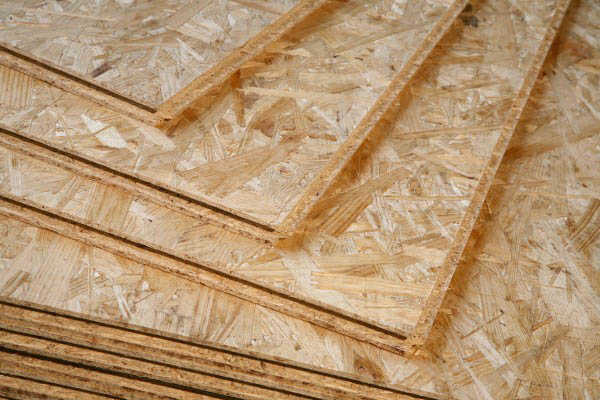
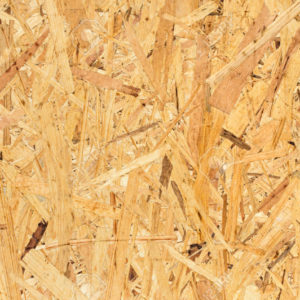
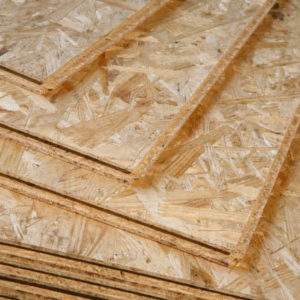
Oriented strand board is manufactured in wide mats from cross-oriented layers of thin, rectangular wooden strips compressed and bonded together with wax and synthetic resin adhesives (95% wood, 5% wax and resin).
The adhesive resins types used include: urea-formaldehyde (OSB type 1, non-structural, non-waterproof); isocyanate based glue (or PMDI poly-methylene diphenyl diisocyanate based) in inner regions with melamine-urea-formaldehyde or phenol formaldehyde resin glues at surface (OSB type 2, structural, water resistant on face); phenol formaldehyde resin throughout (OSB types 3 and 4, structural, for use in damp and outside environments).
The layers are created by shredding the wood into strips,
which are sifted and then oriented on a belt or wire cauls. The mat is made in
a forming line. Wood strips on the external layers are aligned to the panel’s
strength axis, while internal layers are perpendicular. The number of layers
placed is determined partly by the thickness of the panel but is limited by the
equipment installed at the manufacturing site. Individual layers can also vary
in thickness to give different finished panel thicknesses (typically, a 15 mm
(0.6 in) layer will produce a 15 cm (5.91 in) panel thickness[citation needed]).
The mat is placed in a thermal press to compress the flakes and bond them by
heat activation and curing of the resin that has been coated on the flakes.
Individual panels are then cut from the mats into finished sizes. Most of the
world’s OSB is made in the United States and Canada in large production
facilities. The largest production facilities can make over 1,000,000 square
feet (93,000 square metres) of OSB per day
The resins used to create OSB have raised questions regarding the potential for OSB to emit volatile organic compounds (VOCs) such as formaldehyde. Urea-formaldehyde is more toxic and should be avoided in home use. Phenol-formaldehyde products are considered to be relatively hazard-free. Some newer types of OSB, so-called „New-generation“ OSB panels, use isocyanate resins that do not contain formaldehyde and are considered non-volatile when cured. Industry trade groups assert that formaldehyde emissions from North American OSB are „negligible or nonexistent“.
Some manufacturers treat the wood chips with various borate compounds which are toxic to termites, wood boring beetles, molds, and fungi, but not mammals in applied doses.
Types
Five grades of OSB are defined in EN 300 in terms of their mechanical performance and relative resistance to moisture:
OSB/0 – No added formaldehyde;
OSB/1 – General purpose boards and boards for interior fitments (including furniture) for use in dry conditions;
OSB/2 – Load-bearing boards for use in dry conditions;
OSB/3 – Load-bearing boards for use in humid conditions;
OSB/4 – Heavy-duty load-bearing boards for use in humid conditions
- osb3-cz-ce-certificate-2019-04-30
- kronospan-osb-cze
- ofss-cz-pko-16-30-steny
- osb-firestop-classification-report-130914-till-2023-07-31
- airstop-cz-ce-certificate-002641-2019
- osb-en-blauer-engel-32609-en-22-02-19
- k-board-cz-ce-certificate-2016-10-10
- firestop-cz-certificate-ce-2016
- DIBt-Gutachten-OSB3-K-Board-OSB3-Spruce-9-30mm-2020
Our index:
Sustainability index:
price index: